On November 21, maritime authorities reported two impacts on tankers leaving the Strait of Hormuz near Khasab, Oman. Around the same time, Iran’s navy said a tanker had caught fire after hitting a mine in a restricted area east of the strait. The reports establish a serious series of incidents in a strategic passage. They do not yet show that the two British maritime alerts and Iran’s account refer to the same ships, or identify the source of the projectiles. That distinction, often compressed in headlines, is central to the story: in a crisis over navigation, uncertainty itself can exert pressure.
1. What the alerts establish—and what they leave open
The United Kingdom Maritime Trade Operations center (UKMTO) issued two separate warnings for November 21. The first placed an incident 11 nautical miles north of Khasab: an outbound tanker in the strait had reportedly been struck on the stern by an unidentified projectile. The second placed another incident 17 nautical miles east of Khasab: an outbound tanker had reportedly been hit in the engine room by an unidentified projectile. Both warnings said there were no reported casualties and that the environmental impact was unknown. They drew on military authorities, not a publicly released independent forensic examination of hull damage or debris.
Neither alert named the vessels, their flags, owners, cargoes or destinations. Most important, neither identified an attacker. “Unknown projectile” describes the information available to UKMTO; it is not coded attribution to Iran. The reported locations are distinct, but proximity and timing do not by themselves establish with certainty that two different hulls were involved: Reuters explicitly said it was not immediately clear whether the alerts concerned the same vessel or two. The distinction matters when describing the number of ships; the available evidence supports two alerts, not necessarily two separately identified vessels.
The warnings establish that a maritime authority received credible reports of commercial-vessel damage and advised caution. They do not establish whether the ships were disabled, whether cargo was affected, whether pollution occurred or whether owners suspended transit. This is not a semantic quibble. Damage to a ship is a security event; a shutdown of a trade route is a separate economic consequence requiring separate evidence. Neither UKMTO warning said the strait had been closed.
2. Iran’s account is separate from the British alerts
On the same day, Iran’s navy said in state media that a tanker caught fire after hitting a naval mine in a restricted area east of the strait. Iranian media also described operations intended to stop vessels that did not comply with Tehran’s restrictions. This is a primary source for what Iranian authorities said or claimed. It is not independent confirmation of a particular incident, its cause, the ship’s identity or the legal status of the area described.
Reuters treated these as separate strands: the UKMTO warnings referred to unknown projectiles near Khasab; Iran’s navy described a mine east of the strait. The agency said it could not verify Iran’s account or establish whether it referred to either incident reported by UKMTO. The Associated Press summarized at least three tankers attacked “in or near” the strait, combining the two projectile reports with Iran’s mine statement. That is defensible as a summary of claims circulating that day. It should not be read as three independently confirmed attacks or three certainly distinct ships.
The different wording reflects different evidence. “The vessel struck a mine” is Iran’s explanation; “unknown projectile” is the UKMTO attribution status. Neither is a published forensic investigation. The mine may have been a separate event, a competing explanation or an incident described differently by different authorities. Open sources available by November 22 do not resolve this. Treating the most dramatic account as the most established would hide what readers need to know: authorities have incomplete information, and parties have political interests in how incidents are described.
3. Why the strait gives each doubt global weight
Khasab lies on Oman’s Musandam Peninsula, close to the entrance of the Strait of Hormuz. Before the Iran war, nearly one-fifth of global crude-oil supply passed through the strait, Reuters reported. The International Maritime Organization (IMO) notes that ships use an internationally recognised traffic separation scheme and highlights the obligations of maritime safety. The strait’s economic importance does not mean every incident immediately reduces global supply. It means persistent risk perceptions can change decisions by shipowners, crews, insurers and buyers.
A tanker need not sink to create strategic costs. A hit to an engine room can trigger inspection, repair, an insurance inquiry and route reassessment. Crews may seek higher risk compensation; companies may slow transits; insurers may tighten terms; ports may have to handle damaged vessels. These responses have not all been confirmed for the November 21 incidents. They are the channels through which a credible threat can spread. A low-level but repeated risk can raise costs without a dramatic closure announcement.
The IMO had already recorded more than 130 attacks on commercial vessels in the strait since February 28, 2026, with at least 25 seafarers killed, in its November 11 statement. Its public list of confirmed incidents was current only through November 17 and therefore could not validate the events of November 21. Still, the list makes clear that the reports came amid a much broader campaign against shipping, not in a vacuum. The IMO also raised concerns about fraudulent flags, vessels concealing IMO numbers and unsafe transits. The crisis has multiple layers: attacks, claimed transit restrictions, risky maritime practices and blockade measures.
4. The consensus runs ahead of the evidence
Some headlines on November 21 described the events as Iranian strikes on three tankers. That framing draws on context: Iran has threatened to control passage, state media reported naval operations, and commercial ships have been damaged in the same area during the war. But moving from a plausible context to a certain attribution is not automatic. The two British alerts said “unknown projectile”; Iran’s statement concerned a mine under a different description; Reuters said it had not been established that the Iranian account matched the UKMTO reports. Iranian responsibility may be a strong hypothesis given the wider setting, but public information available on November 22 does not prove who launched each projectile.
The reverse bias would be to treat uncertainty as exoneration or as a reason to minimize the damage. Ships were reported hit; the risk to seafarers and traffic is real even if the attacker is unknown. A rigorous account has to hold three propositions at once: there are serious reports of vessel damage; the projectiles’ public attribution is unresolved; and Iran separately reported or claimed an incident involving a mine and transit restrictions. Dropping any of those in favour of a simpler story weakens the analysis.
Media framing also slides from “ships were attacked” to “Iran is conducting a campaign to close the strait.” The latter is a strategic interpretation supported by threats, the U.S. blockade of Iran’s ports and earlier attacks, but it is not proven by two isolated incident warnings. A campaign could aim to impose costs, signal capability or enforce a passage rule Tehran has proclaimed without seeking total closure. It could also be a sequence of tactical decisions and incidents whose command arrangements are opaque. The distinction matters: a response premised on deliberate closure could accelerate a confrontation that the reported facts do not make inevitable.
5. Game theory explains why ambiguity can be useful
In a coercive game, an actor tries to alter another’s choices by increasing the cost of non-compliance. Tehran has an incentive to show that passage through the strait cannot be separated from its political conditions, particularly while Washington maintains a blockade of Iranian ports. Yet openly claiming every impact would carry costs: it could strengthen the other side’s case for retaliation, rally littoral states against Iran and imperil mediation channels. Ambiguity can provide pressure at lower diplomatic cost: companies see danger, while governments hesitate to respond to an incomplete attribution.
This reasoning does not prove Iran organised the attacks or deliberately chose ambiguity. It describes a possible mechanism to test, not knowledge of secret decisions. Other explanations remain plausible: the projectiles could have come from another group or state actor; an operation might have gone wrong; Iran’s reported mine incident might have been real and separate; or a party may be exploiting incidents it did not cause. Evidence that could distinguish these scenarios would include debris analysis, timestamped radar or satellite data, ship logs, crew testimony and a verifiable match between the location of Iran’s claimed mine incident and the damage reports.
The sequence also creates a commitment problem. The United States can escort vessels and reaffirm freedom of navigation; Iran can say certain ships are using a prohibited route; shipowners cannot be sure restraint will be reciprocal. An escort may reduce interception risk but be interpreted as provocation. A diversion may protect crews while increasing costs and convincing Iran that pressure is working. Sailing without an escort preserves commercial normality until the next incident, but directly exposes seafarers. Each company’s prudent choice can therefore produce a collective slowdown even without an official decision to close the strait.
6. Different actors are playing for different gains
Washington wants to keep navigation open while enforcing its blockade, objectives that can conflict: an escort may protect one convoy but endanger the next. Tehran uses access as leverage; Oman wants to prevent the corridor becoming a battlefield; crews and carriers seek safety and predictability.
In this multi-level game, governments choose operations and messages; companies assess risk; insurers adjust premiums. An incident can slow trade without an official closure. Coercion may come from private actors’ cautious response when they cannot know which ship will be hit next.
Seafarers bear this uncertainty first. The IMO has documented at least 25 deaths in the wider campaign since February. Their safety requires rescue, medical care, pollution prevention and rules that apply to all—not merely protection of cargoes.
7. Serious counterarguments
One serious objection is that excessive caution could give Iran plausible deniability while ships divert. Uncertainty does not preclude temporary defensive measures; it does preclude presenting an unproven attribution as fact. States can increase surveillance, share data and protect crews while an investigation continues.
Another argument is that Iranian restrictions are merely a reaction to an unlawful or coercive American blockade. Explanation and legal justification are different questions. The blockade must be assessed under applicable law and the circumstances of the conflict; Iran invokes its own rules for passage. But the status of a route or vessel is not determined solely by a belligerent’s unilateral declaration. Freedom of navigation and the safety of civilian ships are separate legal and humanitarian interests in the dispute between Washington and Tehran. A commercial vessel does not automatically become a lawful target because one party labels it “unauthorised.”
Finally, repeated incidents could reflect mistakes, multiple actors or damage unrelated to a coordinated campaign. Caution does not rule out Iranian responsibility; it prevents plausibility, official statements and physical proof from being conflated. That standard also protects the credibility of future investigations. If debris, a navigation record or crew testimony confirms a link, stronger attribution will be warranted. If evidence points elsewhere, a premature narrative could prompt retaliation on a mistaken basis.
8. What could reduce uncertainty
Authorities should publish, where security permits, time, position, damage, pollution and crew status. The IMO can update its register after validation; its list through November 17 does not confirm the November 21 reports.
Diplomatically, the parties could state observable minimum rules: transit corridors coordinated with Oman, immediate exchange of alerts, an incident-investigation mechanism, protection for rescue operations and a prohibition on using civilian ships as bargaining instruments. Such an arrangement would not require a comprehensive peace deal. It would reduce the chance that disputed evidence becomes a pretext for a new strike. The rules would also need to apply beyond one side: every state imposing restrictions, escorting ships or conducting operations in the area should explain how it assesses civilian risk and maritime obligations.
Indicators to watch are concrete: incidents confirmed by different sources, IMO verification, traffic volume and waiting times, diversions, published insurance costs, shipowner restrictions, pollution and casualties among crews. A declaration of intent or a triumphant communiqué is not enough. A return of ships to the corridor accompanied by safeguards and fewer incidents would be more informative than a ceasefire announcement alone. Conversely, materially attributed strikes, fatalities or an imposed closure would mark a sharper escalation.
9. Conclusion: do not turn the unknown into political certainty
On November 21, UKMTO reported two impacts on outbound tankers at 11 nautical miles north and 17 nautical miles east of Khasab; the projectiles were unknown, no casualties were reported and pollution had not been established. Iran’s navy separately said a tanker caught fire after hitting a mine in a restricted area. Reuters could neither verify that account nor connect it to the UKMTO warnings. AP summarized at least three tankers attacked, but that count combines two official alerts with an Iranian statement; it does not prove three distinct attacks by identified perpetrators.
The consensus to question is not that Iran can threaten navigation: its proclaimed restrictions, earlier incidents and the blockade context give that reading a basis. The stronger claim—that the day’s alerts establish who launched every projectile and prove a unified plan to close the strait—goes beyond the available evidence. Game theory suggests ambiguity can itself coerce: if shipowners and insurers reduce transits, the strategic effect may appear before any military closure is declared. But that remains an inference to test against commercial decisions and evidence of attribution.
The priority should be to protect crews, preserve evidence, document impacts and maintain a navigation mechanism involving Oman and flag states. Political responses may prepare for risk; they should not misstate the strength of the evidence. In Hormuz, the difference between what happened, what Iran says happened and what observers infer is not a wording detail. It is part of collective security.
Sources and method
- UKMTO Warning 215-26 — incident reported at 05:00 UTC, unidentified projectile, tanker stern, 11 nautical miles north of Khasab.
- UKMTO Warning 216-26 — incident reported at 05:50 UTC, unidentified projectile in engine room, 17 nautical miles east of Khasab.
- Reuters, November 21, 2026 — compares UKMTO reports with Iran’s statement and notes the lack of a confirmed link.
- Associated Press, November 21, 2026 — summary of reported incidents and Iran’s stated position.
- International Maritime Organization, November 11, 2026 — more than 130 confirmed attacks on commercial vessels since February 28 and at least 25 seafarers killed as of publication.
- IMO confirmed-incidents register — public list reviewed, current through November 17, 2026.
- Earlier System Skeptic Speaks analysis on the Gulf.
Updated November 22, 2026. System Skeptic Speaks Editorial Desk.
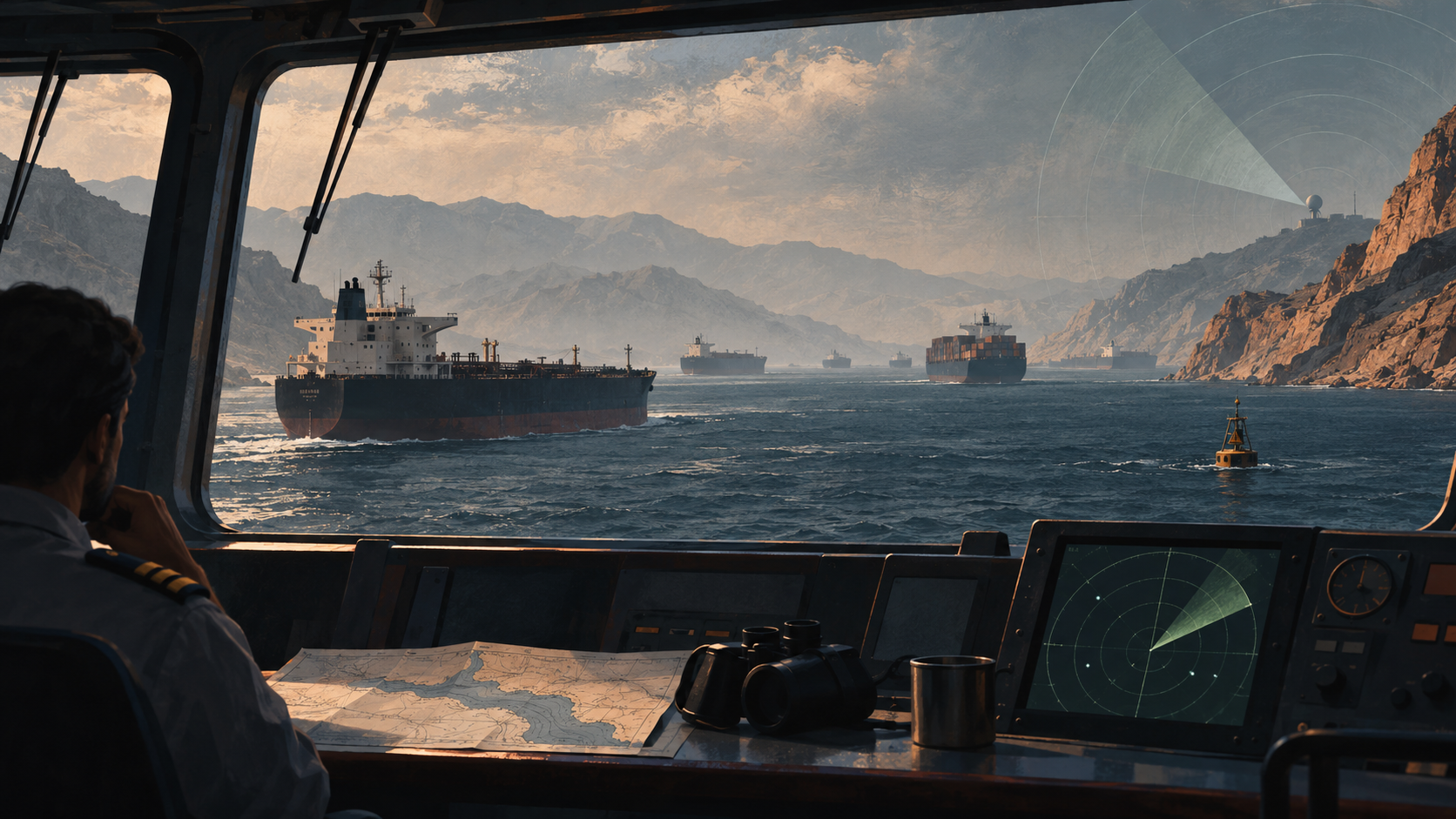
Method note: UKMTO alerts and Iranian official statements are treated as separate evidence. The alerts describe unknown projectiles and do not name an attacker; Iran’s mine statement has not been independently linked to them. The argument that ambiguity can function as coercion is a strategic hypothesis, not evidence of intent. Public sources cited here do not establish the ships’ full damage or subsequent effect on traffic. Cover illustration generated with AI; it is not documentary photography.
Read the French edition. https://systemskepticspeaks.com/index.php/2026/11/22/hormuz-tankers-attribution-incertaine/