The first US–Iran contacts in months may be significant. But the public evidence shows renewed bargaining under pressure—not yet a shared path to peace.
1. What happened?
On 23 September, US and Iranian representatives resumed indirect contacts on the sidelines of the United Nations General Assembly. Reuters reported that US envoys Steve Witkoff and Jared Kushner communicated with Iranian Foreign Minister Abbas Araghchi through mediators. President Donald Trump described the exchange as productive and said there was momentum toward a deal, while Iranian officials continued to frame the reopening of the Strait of Hormuz and the end of US military pressure as conditions for progress.
Three points are confirmed by different kinds of sources:
- The White House publicly presented Trump’s UN speech on 22 September as a case for US strength and continued pressure on Iran. White House, 22 September 2026: https://www.whitehouse.gov/releases/2026/09/president-trump-at-the-united-nations-while-others-have-talked-i-have-acted/
- Qatar’s foreign ministry confirmed a 22 September meeting between its prime minister and Iran’s foreign minister about de-escalation and conditions for dialogue. Qatar Ministry of Foreign Affairs, 22 September 2026: https://mofa.gov.qa/en/qatar/latest-articles/latest-news/details/2026/09/22/prime-minister-and-minister-of-foreign-affairs-meet-iran%27s-foreign-minister
- Reuters reported the 23 September mediated contacts, but also noted that neither side publicly announced a change in its position. Reuters report, 23 September 2026: https://www.investing.com/news/commodities-news/hope-for-progress-after-us-iran-hold-first-shuttle-talks-in-months-4912555
The central uncertainty is not whether communication occurred. It is whether communication can produce a credible sequence of reciprocal concessions while both sides still believe that pressure may improve their bargaining position.
2. The consensus story is too simple
The dominant headline is familiar: after months of war, diplomacy has restarted. That is true, but incomplete. The more consequential fact is that diplomacy has restarted without a visible settlement on the issues that made previous arrangements collapse.
The public record still shows incompatible opening positions. Washington presents the conflict as a test of deterrence, nuclear non-proliferation and freedom of navigation. Tehran presents the war and the maritime restrictions as a coercive assault that must be answered before normal navigation and wider regional arrangements can return.
Both narratives may be strategically useful without being sufficient descriptions of the underlying game. The negotiations are not simply about whether the two governments prefer peace. They are about who must move first, what can be verified, what each leader can sell domestically, and whether a concession today creates vulnerability tomorrow.
3. A game-theory reading: the first mover pays twice
This is a sequential bargaining game with incomplete information.
The United States wants evidence that Iran will not use a pause to rearm, preserve leverage over Hormuz or maintain regional pressure through aligned armed groups. Iran wants evidence that a concession will not be followed by renewed strikes, tighter blockades or demands that expand after Tehran has surrendered its strongest bargaining chips.
That creates a first-mover problem. If Iran reopens the strait before sanctions or military pressure ease, it may lose leverage without receiving a durable guarantee. If Washington eases pressure before seeing a verifiable maritime or nuclear concession, it may lose coercive credibility without changing Iran’s long-term calculations.
Mediators help because they make small, ambiguous moves possible. Qatar can carry messages, translate red lines and reduce the political cost of direct contact. But mediation does not solve the commitment problem. It only makes communication less expensive.
The likely equilibrium is therefore not a grand bargain at the first meeting. It is a series of reversible signals: limited maritime measures, monitored pauses, humanitarian or financial steps, and carefully worded statements that allow each side to claim it has not capitulated.
4. Hormuz is more than a shipping corridor
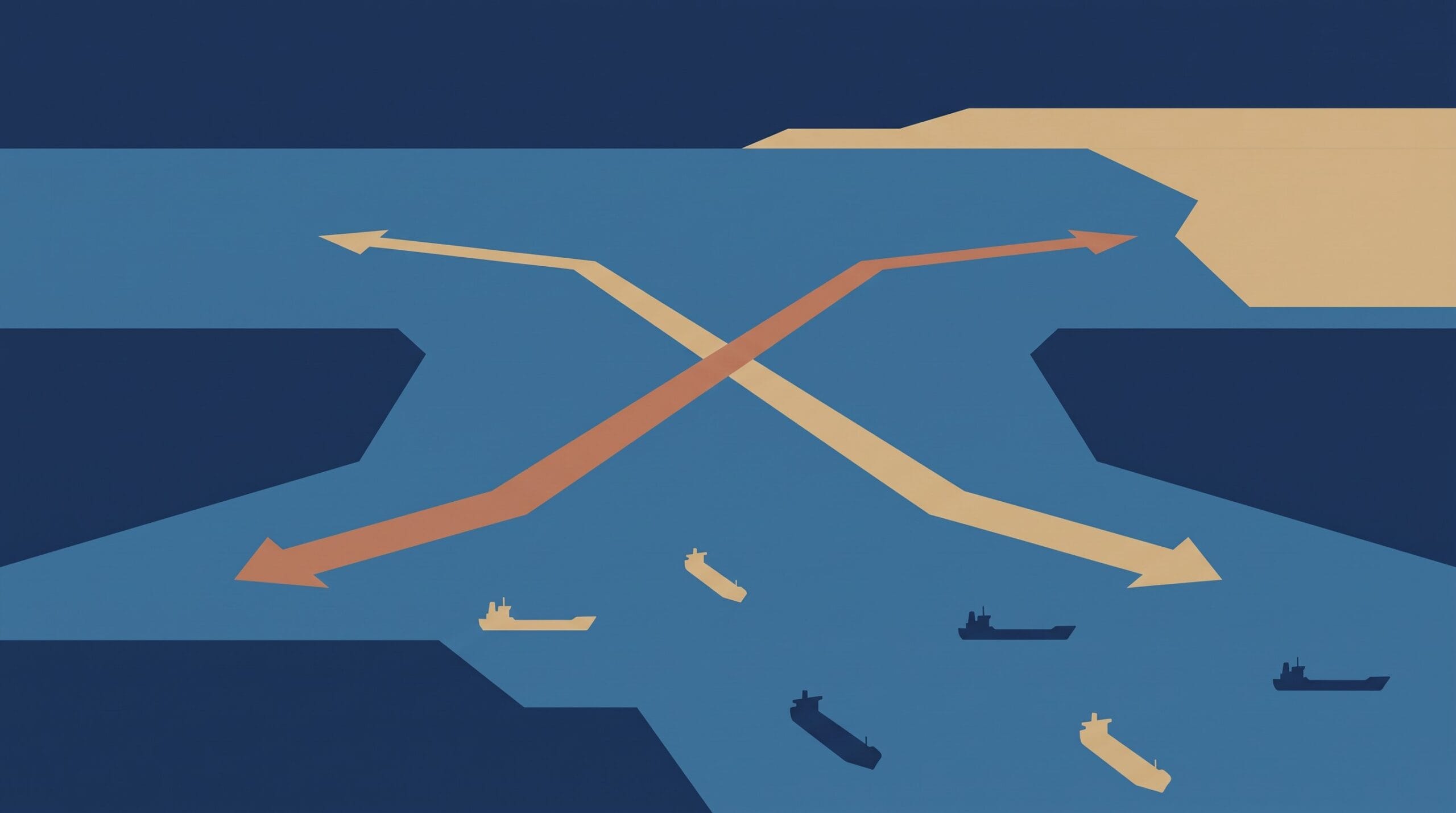
The Strait of Hormuz is being described primarily as an economic emergency. It is also a bargaining instrument.
For Iran, control over the pace and conditions of maritime access can convert military vulnerability into negotiating leverage. For Washington and Gulf states, restoring navigation is both an economic objective and a test of whether coercion has produced a strategic result. For Qatar and Oman, mediation over navigation offers influence that military alignment alone would not provide.
This creates a repeated game. Every ship that moves safely can reduce the perceived value of escalation. Every attack, interception or ambiguous incident can restore the value of threat. Commercial actors—insurers, shipowners and commodity traders—then become part of the signalling system: their decisions reveal how much credibility each side’s guarantees actually possess.
The danger is that a measure intended as leverage becomes a domestic symbol. Once leaders publicly tie reopening the strait to victory, lifting the restriction can look like surrender even if it is exchanged for a larger strategic gain.
5. What the evidence does not establish
The evidence does not establish that a durable agreement is close. Reuters explicitly reported that neither side had publicly changed its position. Qatar confirmed contact with Iran, but its statement did not announce a US–Iran agreement. The White House speech demonstrated political intent and threat framing, not a verified negotiating offer.
Nor does the evidence prove that the contacts are merely theatrical. The fact that senior envoys and regional mediators were active at the UN is a meaningful signal: both sides are preserving a channel at a moment when escalation remains costly.
The best-supported conclusion is narrower: the parties are testing whether the bargaining space has reopened. That is strategically important, but it is not the same as peace talks producing an enforceable settlement. Associated Press coverage of the UN context: https://apnews.com/article/692e1e171a791be0c9b9c1f56718a0d0 likewise describes an administration still publicly combining negotiation with threats of escalation.
6. Serious counter-arguments
One interpretation is that pressure is working. On this view, Iran’s willingness to communicate through mediators shows that military and economic coercion has changed its cost-benefit calculation. If so, maintaining pressure may be the fastest route to a deal.
Another interpretation is that Tehran is using diplomacy to buy time, reduce international isolation and preserve its maritime leverage. If so, optimistic public statements from Washington could weaken the coalition’s resolve before verification exists.
A third interpretation is that both sides are responding to practical limits rather than changing strategy. The war has imposed costs on energy markets, regional governments and military inventories. Talks may therefore be a safety valve—a way to manage escalation—without resolving the underlying contest.
These explanations are not mutually exclusive. A coercive bargaining process can generate real diplomacy while still producing only a temporary equilibrium.
Conclusion: watch the sequence, not the headlines
The first US–Iran shuttle contacts in months matter because they show that the channel is not dead. But the strongest public evidence points to a bargaining process under coercion, not a diplomatic breakthrough.
The decisive test will be sequence and verification: what moves first, what is independently monitored, what is reversible, and what happens when a party claims non-compliance. A headline about “momentum” is cheap. A credible commitment that survives the first disputed incident is expensive—and therefore informative.
The consensus should be questioned in both directions. It is too early to declare peace, but also too simple to dismiss the talks as theatre. The real contest is over who can create an equilibrium in which restraint becomes safer than escalation for all the relevant players.
Method note
This article examines events first reported or officially documented between 20 and 23 September 2026. It separates confirmed events from interpretation and hypothesis. The analysis relies on the White House statement, Qatar’s official foreign-ministry readout, Reuters reporting, and Associated Press coverage of the UN and regional context. Public reporting does not reveal the full negotiating record, private proposals or verification mechanisms; conclusions are therefore provisional.
Author: System Skeptic Speaks
Updated: 23 September 2026