The new proposal gives Gaza’s recovery a project list and a price tag. But the UN’s latest assessment points to a harder obstacle: the political arrangements and institutions needed to make recovery possible are not yet operating at scale.
1. A plan is not the same thing as a commitment
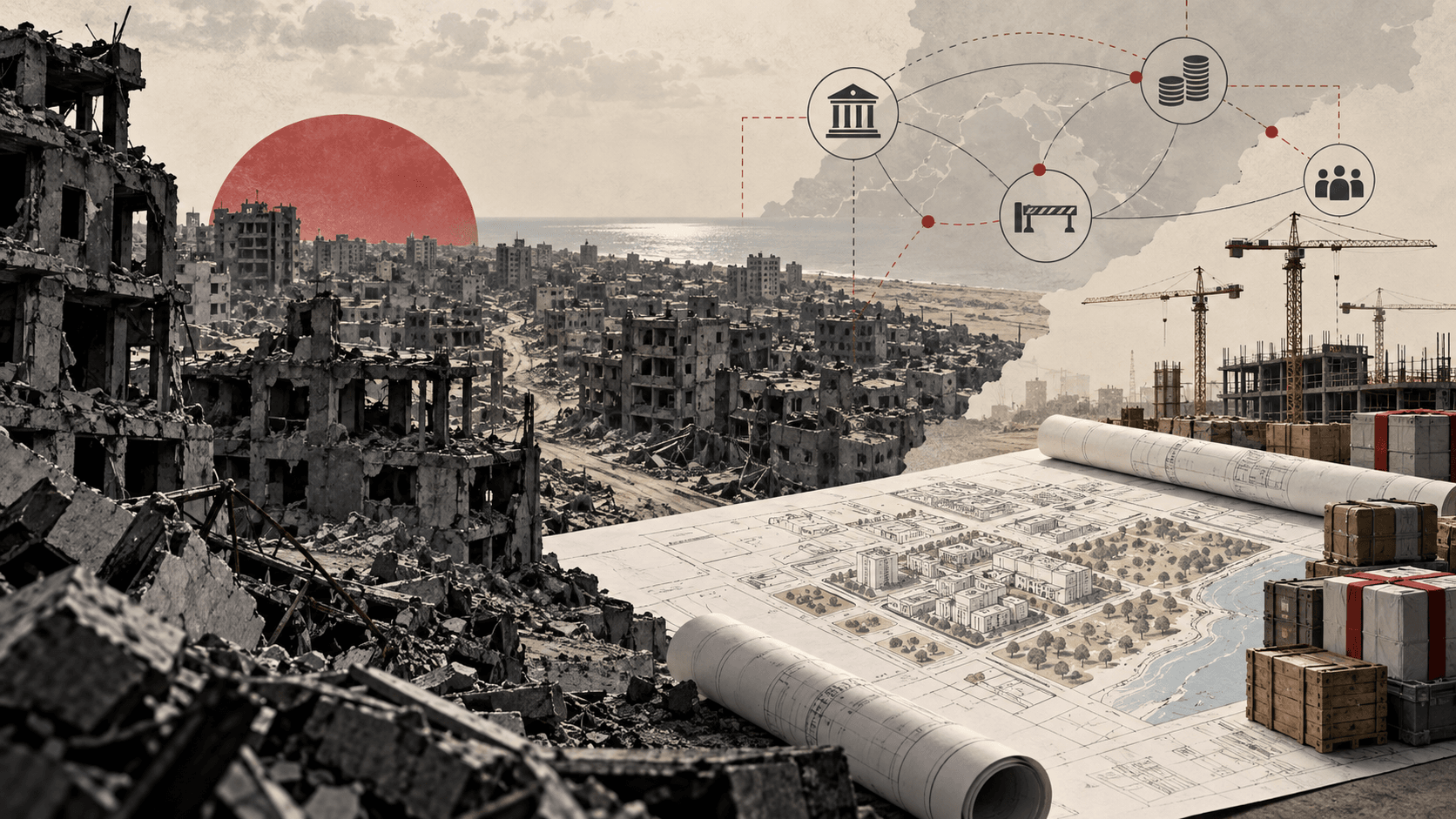
On September 23, President Donald Trump’s Board of Peace presented a $2.45 billion proposal containing 66 programs intended to begin Gaza’s recovery. Reuters reported that implementation remained uncertain, with Israel and Hamas still divided over ceasefire terms, including troop withdrawal and disarmament.
The scale matters. The UN’s latest reconstruction estimate is about $71.5 billion over the coming decade. The proposed $2.45 billion is therefore only a small part of the overall need—but the comparison is imperfect: the Board’s proposal is an initial program, not a full decade-long reconstruction budget. These figures measure different scopes, not a precise funding shortfall. The UNCTAD estimate is based on an assessment conducted with the World Bank and the European Union.
Verified: the proposal exists; its implementation is uncertain. Not established: that the full amount has been secured, or that the projects can begin under current conditions.
UNCTAD’s September 24 report · Reuters on the $2.45 billion proposal
2. The missing variable is operational authority
A September 24 report by the UN Special Coordinator’s office says the transitional arrangements envisaged for Gaza have been established but are not yet operating there. It also says that key financing instruments have not translated into early recovery at scale. The report’s central warning is that reconstruction and the wider political process depend on one another.
That changes the question. It is not only “Who will pay?” but also: who can authorize projects, guarantee access, move materials, provide security, oversee contracts and answer to Gaza’s residents? If those powers are divided among actors who do not trust one another, a donor pledge cannot resolve the impasse.
UNSCO’s September 2026 report · The UN’s summary of its findings
3. A game of sequencing—and mutual vetoes
In game-theory terms, this resembles a coordination problem with several veto players. Donors may hesitate to release funds without reliable access and oversight. Palestinian institutions need resources and authority to demonstrate that governance can function. Israeli security requirements shape what can enter and where work can proceed. Armed groups’ status and the ceasefire’s durability affect every other commitment.
Each actor may prefer that another move first. Donors fear sunk costs if projects are halted; local institutions risk appearing powerless if they accept responsibility without control; authorities with access or security leverage may prefer to preserve that leverage until political conditions are settled.
This is an analytical inference, not evidence of secret intent. It does suggest why a headline funding figure can mislead: the announced plan may signal political ambition without yet creating a credible commitment to deliver. A more credible approach would link funds to transparent, independently verifiable milestones—while ensuring those milestones do not become indefinite preconditions for basic civilian recovery.
4. The strongest counterargument
Security and financial safeguards are not merely bureaucratic obstacles. Without them, funds and materials could be diverted, projects could be destroyed, and infrastructure might not serve residents safely. Donors have legitimate reasons to demand oversight.
But safeguards can also become a mechanism of delay if no actor is responsible for meeting them, or if access and governance conditions remain undefined. The September 24 UNSCO report’s finding—that financing instruments have not produced recovery at scale—makes this distinction urgent.
Al Jazeera’s account of the UNCTAD assessment reports that more than 90 percent of Gaza’s working-age population is unemployed and that 92 percent of economic establishments have been damaged or destroyed, according to the report. These figures describe a collapse in productive capacity, not just damaged buildings.
5. What the evidence cannot tell us
The sources establish the proposed plan, the scale of estimated needs and the UN’s assessment that transitional arrangements and financing mechanisms have not yet produced recovery at scale. They do not reveal the private intentions of governments or predict which bargain will be accepted. Nor does the existence of a plan prove that its projects are funded, authorized or ready to begin.
Conclusion
The $2.45 billion proposal may be a useful starting signal. It is not proof that Gaza’s reconstruction has begun. The decisive test is whether actors with different powers can make commitments that are verifiable and reciprocal: access in exchange for oversight, financing tied to functioning institutions, and security arrangements that do not leave civilian recovery permanently conditional.
The consensus asks how much reconstruction will cost. The harder question is who can credibly guarantee that the money, materials and authority will meet on the ground.
Author: System Skeptic Speaks Editorial Desk
Updated: September 26, 2026
Method note: This analysis distinguishes reported facts from strategic inference. The game-theory framing describes incentives and possible bargaining dynamics; it does not establish any actor’s private motive.